How Our Leadership Development Consulting Works
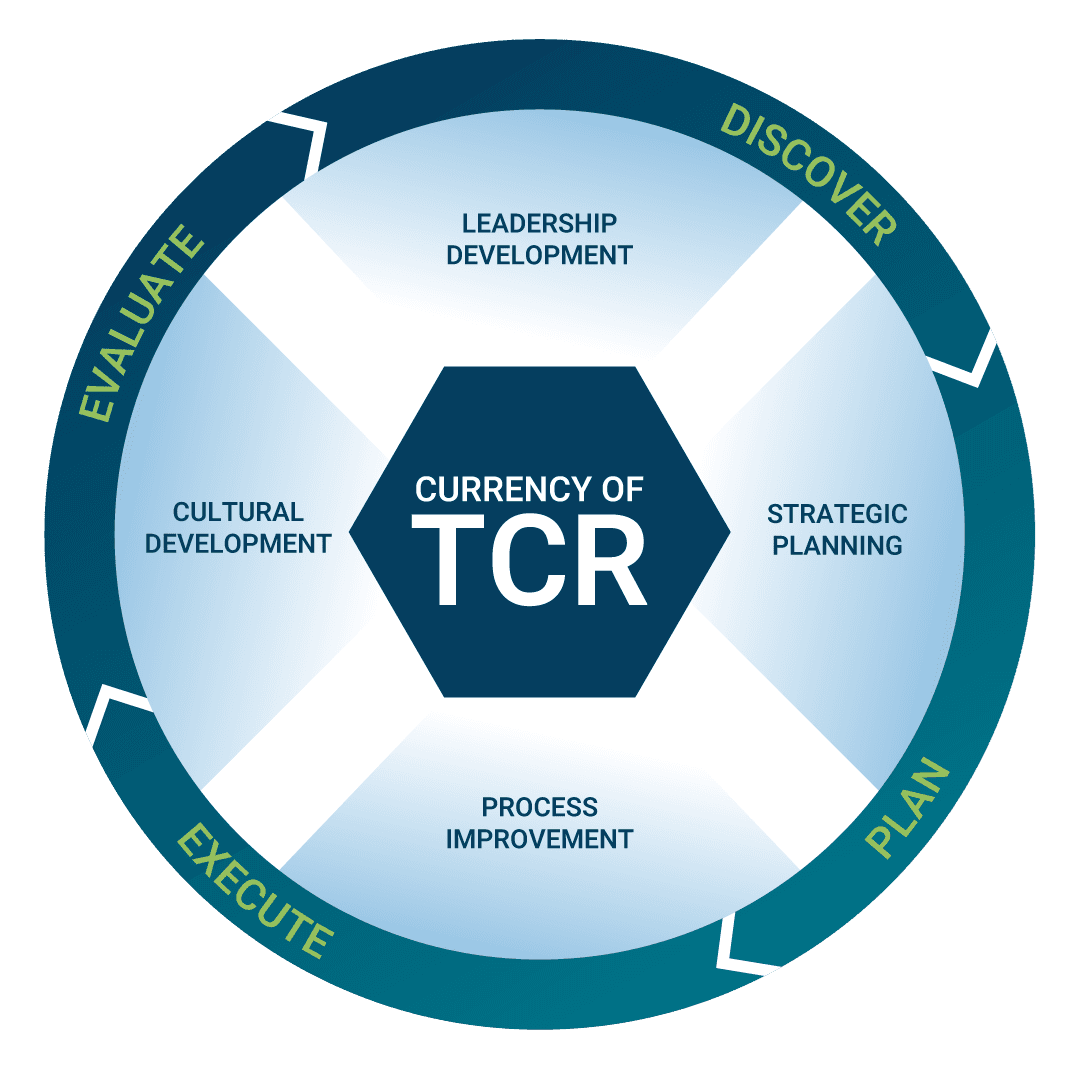
Editorial overview (AI-assisted): Shannon Carver works with leadership teams to examine execution gaps, agree shared expectations, and support coaching and practice in daily work. Discover, Plan, Execute and Evaluate provide the structure; scope, participation and review points are agreed with your organization.
The Leadership System
A continuous cycle of discovery, planning, execution, and evaluation. Every engagement moves through four phases, and the four areas we focus on — leadership development, cultural development, process improvement, strategic planning — are not a separate menu. They are the lenses through which each phase gets applied.
Discover
Understand how leadership is actually showing up
The work starts with honest observation. We sit in on leadership meetings, talk one-on-one with leaders at every level, walk the floor or visit the teams, and run the Execution Gap Diagnostic across the leadership team. By the end of Discover, the leadership team has a shared, honest read on where alignment is strong, where it is not, and where friction is costing the most.
Before engaging outside support, it helps to understand what a leadership consultant actually does and how to choose well.
Where This Shows Up
- Cultural Development — Surfacing the culture leaders actually create day-to-day, not the one stated on the wall.
- Strategic Planning — Mapping where strategy is and is not reaching the floor — and why.
Plan
Define expectations, priorities, and a practical path forward
From what Discover surfaces, we build a development plan tied to your operational priorities — not a generic curriculum. We agree on the leadership behaviors that matter most, where they need to show up consistently, and what good looks like in observable terms. Plans stay short and grounded — typically a 90-day horizon — so the work stays connected to what the business actually needs.
When the gap runs deeper than a plan can close, read When the Execution Gap Is Too Wide to Close from the Inside.
Where This Shows Up
- Strategic Planning — Translating strategy into the leadership behaviors required to execute it.
- Cultural Development — Defining the culture this strategy needs, in observable terms.
Execute
Support leaders with coaching and structure that drives consistency
This is where leadership behaviors actually shift. We work alongside leaders in the flow of their work — coaching before and after key conversations, facilitating alignment rhythms between leadership levels, and reinforcing the behaviors that need to stick. Capability gets built on the floor and in the room, not in a workshop disconnected from operations. The cadence is paced to the engagement: weekly during launch, less often as behaviors hold.
On why the change has to hold across the whole management layer, read When Individual Coaching Is Not Enough. Scope clarification (AI-assisted editorial): Use the lean consulting scope guide to distinguish leadership support from technical process implementation.
Where This Shows Up
- Leadership Development — Building specific leadership behaviors through coaching in real situations — not generic training.
- Process Improvement — Strengthening the operating rhythms — meetings, accountability cadence, decision-making — that those behaviors run on.
Evaluate
Review what is actually changing, not just what is being measured
At regular checkpoints we review what is actually changing. Are decisions moving faster? Is accountability holding between leadership levels? Is execution getting more consistent across shifts and locations? We track observable behaviors and the outcomes they drive — not engagement-survey self-reports. If something is not landing, we adjust. The goal is for the leadership system to keep working after we step back, not for the engagement to keep extending.
See it in practice: How Daniel Unlocked 25% More Output by Shifting to Team-Driven Execution.
Where This Shows Up
- Process Improvement — Adjusting what is not landing; refining the operating cadence as the team matures.
- Leadership Development — Sustained behavior change — not training that fades after a quarter.
How an Engagement Unfolds
Every engagement is shaped to what the organization needs, but the arc is consistent. Discovery surfaces the gaps. Coaching shifts the behaviors. The late stage is about the system holding without us in the room.
- First 30 days
Diagnostic across the leadership team, one-on-one conversations with key leaders, first alignment session with the senior team. People are honest, the gaps are visible, and the plan starts to take shape.
- Months 2–3
Coaching cadence is running. First behavior shifts are visible — meetings get tighter, decisions get clearer, leaders begin citing the same priorities. Friction sometimes surfaces here. That is the work.
- Months 4–6
Org-wide rhythms hold. Leaders at multiple levels are operating from shared expectations. Cross-functional alignment gets noticeably easier. Outcomes — output, retention, decision speed — start to move.
- Months 6–12
The leadership system is running on its own. We pull back; the cadence stays. Leaders are coaching their own leaders. The change is sticky because it is built on behavior — not on us being in the room.
Agree the timeline and review points
Engagement planning note (AI-assisted editorial): The stages above describe a possible progression of the work, not a fixed delivery calendar or a guarantee that output, retention or decision speed will improve by a particular month. Before starting, agree with Shannon what is included, which leaders can participate, what evidence will be reviewed and who may approve changes to scope or timing. Separate activities delivered from changes observed in the organization, and discuss whether to continue, adapt or stop at the agreed review points.
What the Work Produces
The work is shaped to your organization rather than sold as a fixed program. Across the four phases, your leadership team works toward:
- A shared understanding of where leadership alignment is strong, where it breaks down, and which friction matters most.
- A development plan tied to operational priorities and specific, observable leadership behaviors.
- Coaching and operating rhythms that reinforce expectations through meetings, decisions, and accountability.
- Regular checkpoints to review behavior, execution consistency, and relevant outcomes—and adjust what is not working.
The scope, level of involvement, and cadence are defined together. The aim is a leadership system your team can sustain after we step back.
A Collaborative Approach
The system is structured. The engagement is not. We bring the framework; your people bring the context, history, and operational judgment that make it real. The shape of the engagement — how embedded, for how long, at what cadence — gets defined together, as the work reveals what it needs. Start with the problem your organization needs to solve: delayed decisions, unclear ownership, or inconsistent expectations between leadership levels. Identify which senior, HR, operations, and frontline leaders need to participate, what authority they have to act, and which behavior or business measure will show progress. That makes it easier to compare individual coaching with a broader leadership consulting engagement and agree on a scope that fits the work.
What leadership development means across an enterprise
Scope clarification (AI-assisted editorial): Leadership development builds how people lead through learning, practice, feedback and review—not simply completing a course. Across an enterprise, agree the shared behavior or decision the organization needs, then identify how it shows up for senior leaders, middle managers and frontline supervisors. A common expectation does not require every role or location to use an identical exercise.
Before a wider rollout, confirm who sponsors the work, who can authorize operating changes, which managers can support practice and what evidence will inform the next decision. If those conditions differ between teams, review the differences rather than treating attendance in one cohort as proof of readiness everywhere. Use the leadership-development pilot guide to prepare that expansion decision. This is educational scope guidance, not a fixed Lean Leaders Plus program or a forecast of organization-wide results.
Prepare for a leadership consulting conversation
If you are deciding how to start, compare coaching, consulting and training, review the consulting cost-and-scope guide, and use the leadership-development business-case brief to clarify the decision your organization needs to make. These educational resources help prepare a conversation; they are not a fixed Lean Leaders Plus program, price or contract.
Prefer to send a brief first?
Inquiry option (AI-assisted editorial): If you are comparing outside leadership support but are not ready to choose a meeting time, use the contact form to describe one recurring operating problem, which leaders need to participate and the decision you want help making. Keep the summary non-confidential; do not send private employee or customer records. This is an inquiry about fit and scope, not enrollment in a fixed program.
Ready to Strengthen How Your Team Leads
The Execution Gap Diagnostic is a free, 5-minute self-assessment of how you experience execution on your team. Your personalized results highlight patterns in your answers and a starting point for reflection—not a verified diagnosis of your whole organization. No meeting required.